
Writers Need 🇱🇺🇨🇰
(whether we admit it or not)

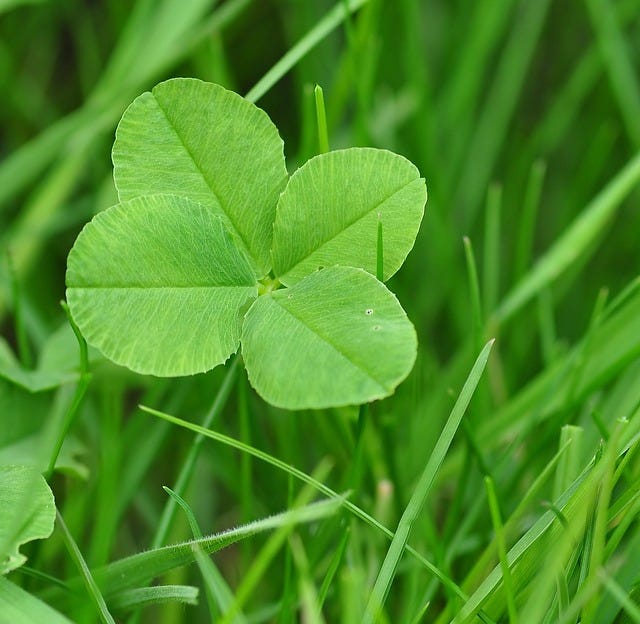
When I taught at a Michigan State University study abroad program in London, guest author Val McDermid surprised my students raising the subject of luck. She discussed writing, of course, but also recounted the lucky breaks she’d had in her career. “There are writers who are as good as I am,” she said, “they just haven’t been as lucky.” She made it very clear that even though talent and hard work were essential, so was luck.
I thought about that when reading Robert McCrum’s entertaining biography of P.G. Wodehouse. The comic writer was immensely talented but also incredibly lucky whether in London or New York. In each city, his timing was right because editors were hungry for the kinds of stories he could write. And in New York, the gifted and speedy poet had no trouble composing witty lyrics in a city where musical comedy had become wildly popular. He also met the right collaborators at the right time, all of which made him Fortune’s darling, not her fool.
I’ve had my share of luck. There was the editor who took over from another and wanted to launch my mystery series when his predecessor was highly dubious about it. And the university library archivist who actively pursued buying my literary papers and made a very lucrative deal with me, a deal I likely wouldn’t have gotten if I lived elsewhere. Then there was my reading at a D.C. venue for my 19th book, My Germany, and someone heading to the embassy in Berlin set a book tour in motion which went so well that they organized another for the next year. These were peal experiences in my career.
But I’ve also had really bad luck. Like the overconfident, high-powered California agent who took a novel of mine to New York and not only goofed by hitting more than two dozen publishers all at once in the hopes of an auction, but she did that just as the stock market was collapsing.
The Germans have a separate word for bad luck, Pech. It deserves its own term because it’s as formidable and potent a force in a writer’s career as the good kind. People in the publishing industry don’t like to talk about luck, and writers sure don’t. There’s a widespread fantasy, especially among newbies, that if you write a good book it will find an audience. Or that there’s some magical form of promotion that will make you a best seller. Currently, social media is supposedly the answer to the eternal question of what will make a book a hit, and there are hundreds of people willing to sell you a how-to book (or their consulting/publicity services) that they promise will reveal the secret to success. Many years ago, a legitimate publicist cost me $1500 and her campaign got me one review and seven book sales.
The real answer is that nobody in publishing really knows what works. Nobody can predict whether a book will be lucky. It’s hard to admit that a book’s fate is so completely out of anyone’s control. But it’s the truth.
I agree with you about the role of luck in a writer's career.
"and there are hundreds of people willing to sell you a book (or their consulting/publicity services) that they promise will reveal the secret to success."
And a whole lot of these are bots preying on authors who want to believe their fabrications.